The deductions self-lodgers miss

Think about the last financial year and ask yourself one question: of everything you spent on the business, how much could you actually substantiate today if someone asked? That is the number that decides your return, not the one you half-remember in July.
- A deduction you cannot substantiate is not a deduction, and the ATO can disallow it
- Written evidence has to show five things, and a bank statement alone is none of them
- Records are kept for five years from the date you lodge, longer for assets and disputes
- Under $300 in total work-related expenses relaxes the receipts, not the proof
Most of what business owners miss is not exotic. It is an ordinary cost that nobody recorded at the time, so by October there is no receipt to put a hand on and nothing to claim against. Not a clever deduction somebody else knows about. Just a cost that went unrecorded.
What written evidence actually has to show
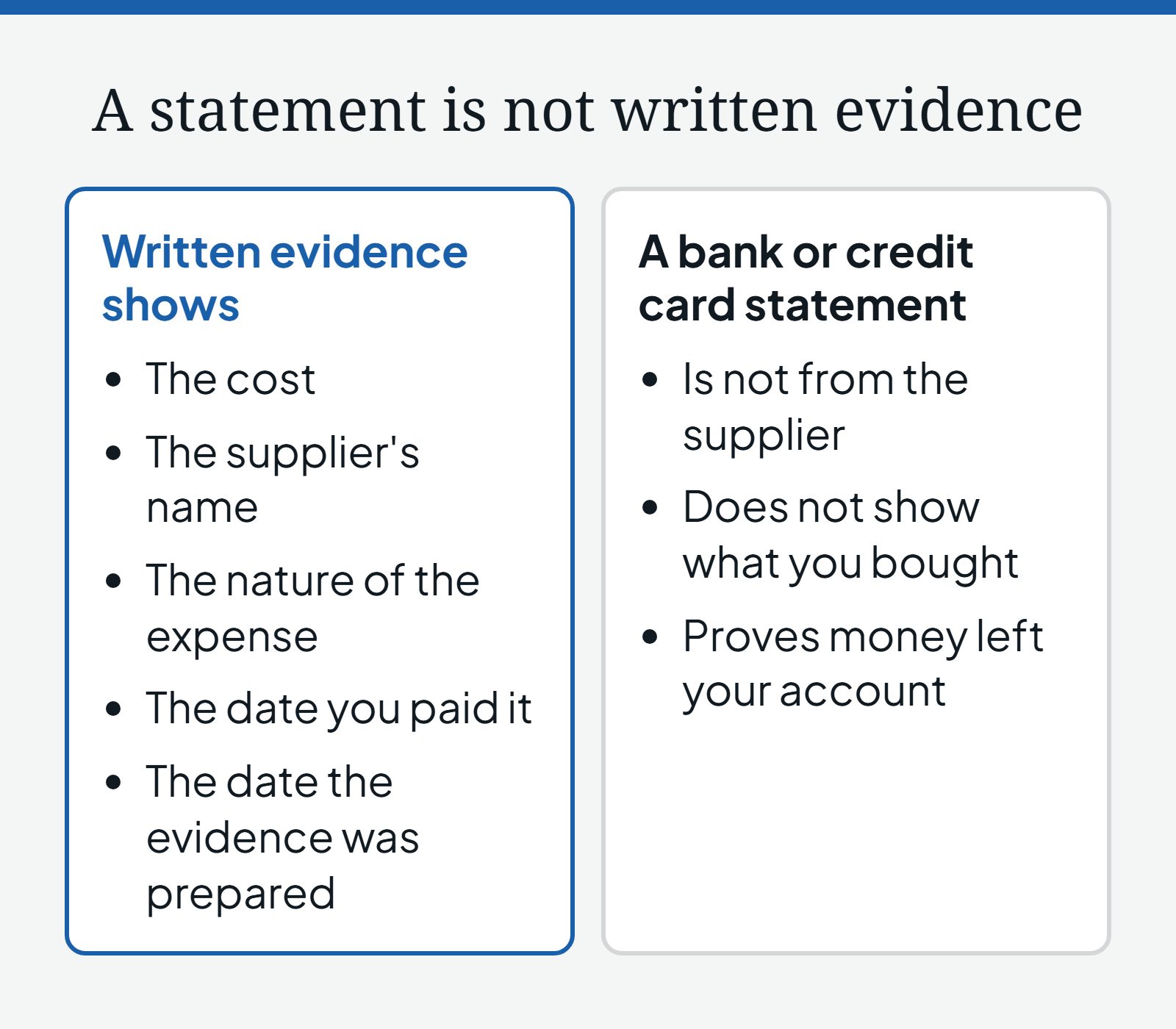
This is the part people get wrong, because they think a receipt is a receipt. To claim a work-related expense the ATO requires written evidence showing the cost, the supplier's name, the nature of the expense, the date you paid it, and the date the evidence was prepared.
You also need a record of how the expense relates to earning your income, including how you worked out the amount and the split between work and private use. You can only claim the work-related portion.
A bank or credit card statement on its own is not written evidence. It is not from the supplier, and it does not show what you bought.
That single rule accounts for a great many disallowed claims. The statement proves money left your account. It does not prove what it left for.
The thresholds that actually exist
There are real exceptions, and they are narrower than the folklore.

- If your total claim for work-related expenses is $300 or less, you can claim without full receipts, but you still have to show you spent the money and how you calculated the claim. It does not apply to car expenses, meal allowances, award transport payments or travel allowance expenses, which have their own rules.
- Laundry of $150 or less can be worked out at $1 a load for your own work clothing, or 50 cents where it is mixed with personal washing. This sits inside the $300, not on top of it.
- Expenses of $10 or less each can be recorded in a diary or a note on your phone instead of a receipt, up to $200 in a year.
None of these is an automatic deduction. Each one relaxes the paperwork, never the requirement that you actually incurred the cost.
How long to keep them
Five years from the date you lodge the return. If you claim decline in value on a depreciating asset, five years from your last claim. For an asset that could trigger capital gains tax, five years after it is certain no CGT event can happen. If you are in dispute with the ATO, the later of five years from lodgement or five years from the dispute being resolved.
Why records are the whole game
Australia runs on self-assessment, which means the ATO accepts what you tell it. If your return is reviewed and you cannot evidence a claim, it can be disallowed. Keeping records through the year is a small ongoing habit; reconstructing twelve months in October is a large one-off task that produces a worse result.
- Photograph receipts at the point of purchase. Photos are accepted records, provided they are a true and clear copy.
- Keep a logbook if you claim vehicle use.
- Record the work-use percentage of anything shared with personal use.
- Keep subscription invoices, which are almost always email-only and easily lost.
- Consider the ATO's own myDeductions tool, which stores records and pre-fills your return.
Keep more receipts, not fewer. Many business owners think a receipt is not important, or that the cost cannot be claimed at all. Keep every receipt that relates to your business or to earning an income. We would rather you keep more receipts than throw out the ones you could actually claim. This is why we suggest businesses use Hubdoc.
Source: Records you need to keep at the Australian Taxation Office, last updated 8 June 2026. Every threshold and retention period above comes from that page. Reviewed 1 September 2026. Your circumstances decide what you can claim, so if a deduction is worth real money to you, have it checked before you lodge rather than after.
Our tax returns and tax accounting service reviews every return with you before anything is lodged.
Get your time back from your books
Book a free 30-minute Initial Discovery Session. Tell us what is going on in your file, and we will tell you what we would do about it.
Related plain-English guidance

Bookkeeper or accountant, and who is allowed to lodge what
Ask yourself one question: who currently checks that your bank reconciliation agrees with your bank statement, and...

When your BAS is due, and what to check before it is
The due date is the easy part to look up and the wrong thing to worry about. What decides whether a BAS is right is...